Every record an auditor might ask for
The cold room is part of a larger system. ChirpDat follows the conditions, the doors, the electrical and the equipment around it — and keeps the record. Find your case below, or price a deployment in three minutes.
- Built for USDA-inspected facilities
- Alerts in minutes, not Monday
- Audit-ready records in one click

Cold chain compliance for USDA & food facilities
Coolers, freezers, blast chillers, aging rooms, and hot-hold — monitored continuously against the critical limits in your HACCP plan, every reading time-stamped and tamper-evident. When USDA’s Food Safety and Inspection Service (FSIS) asks for six months of cooler records, that is one click and two minutes.
We monitor: cooler/freezer temperature, food-grade insertion probes, ambient temp + humidity
Typical alerts: warning at drift, critical at limit — SMS and email to QA, voice-call escalation after hours
The chain that ends in a warm room
Cold storage failures tend to run the same course. Something goes wrong with the power. The compressor works harder, or stops. The room warms up.
Most monitoring only watches that last step — by then the failure has already happened.
ChirpDat can watch the whole chain — so when something moves, you have the conditions surrounding it, not just the symptom.

Always recording
24/7 automated monitoring and event detection, logged as it happens.

Alerts that reach a human
Warning and critical alerts by SMS, voice call, email, and webhook.

Calibration that never lapses
NIST-traceable sensor calibration, renewed annually.
NIST-traceable calibration
The power. Current draw at the panel, phase by phase — a room that is not being cooled is on a clock, and you know the moment it starts.
The compressor. Current sensors detect the moment a compressor stops drawing power — hours before the temperature climbs high enough to trigger a thermal alarm. Power-state monitoring does the same for anything with a plug.
The room. Temperature and humidity, continuously, and the record an inspector will ask for.
How far down the chain you go is your call. We audit the facility and show you what can be monitored.
What that looked like in practice
One customer asked for a single thing: tell us when grid power goes down.
Monitoring the panel to answer that also showed a phase drawing 10.4 amps against 25.4 and 24.2 on the other two — an imbalance nobody was looking for. That put the condition where it actually was: at the panel, not inside any one compressor. Rural power has characteristics you have to measure, not guess at.
They asked for an alert. They got a baseline.
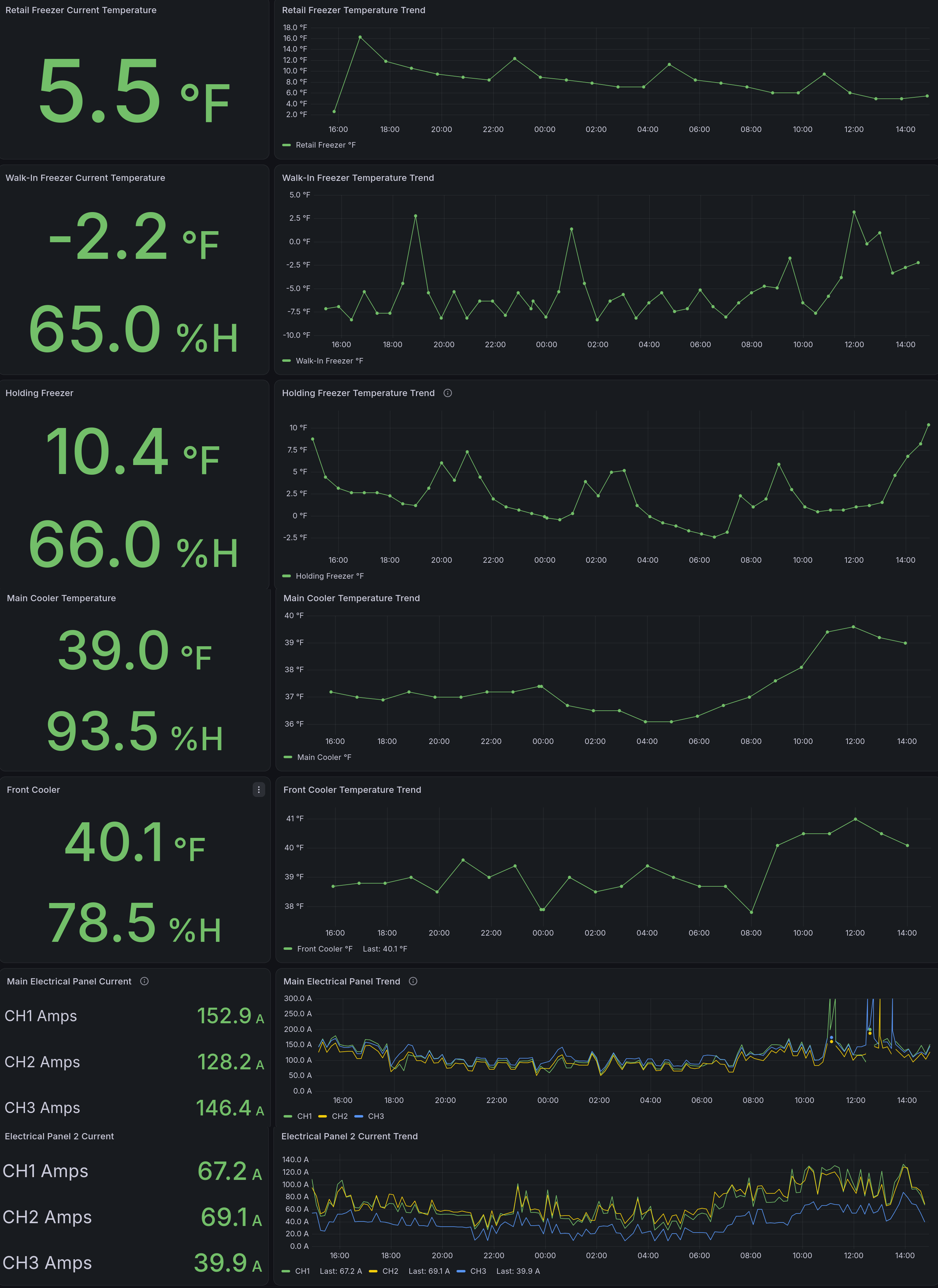
We monitor: panel current by phase, equipment current (compressor-stopped detection), power/socket state, temperature and humidity
Typical alerts: critical voice call the minute current drops — the alert that saves a freezer of product
Doors tell the truth
A propped cooler door is invisible on a paper log and obvious in your data. Door-contact monitoring time-stamps every open and close, alerts when a door stays open past your limit, and builds a chain-of-custody record for when product integrity is questioned.
We monitor: door and access contacts on coolers, freezers, and product areas
Typical alerts: warning at 10 minutes open, critical at 30 — SMS to the floor lead
Document the conditions, not just the temperature
Water where it shouldn’t be, ammonia near refrigeration equipment, CO2 in enclosed spaces — risks insurers ask about and inspectors notice. Continuous detection with a documented response history turns “we check regularly” into a record you can show.
We monitor: water leak (spot and zone), gas detection including ammonia, CO2 and air quality, pipe pressure, tank/bin level
Typical alerts: critical on detection, to maintenance and management simultaneously — with webhook into your maintenance system
Same compliance engine, different walk-in
Cold storage & distribution
Customer-facing proof of cold chain integrity, dock-door discipline.
Dairies & creameries
Tank temps, pasteurization support records, CIP water temps.
Co-packers
Per-client compliance documentation that wins audits and contracts.
School & institutional kitchens
Health-department-ready logs without the clipboard.
Pharmacies & clinics
Vaccine and medication storage records, out-of-range documentation.
Price your deployment in three minutes
Pick your zones, set your alert rules, see your number.
- Published rates — no email required
- An estimate at published rates, not a quote
- Built for USDA-inspected facilities